
Music Source Separation With AI
Author Reference: Sean Kim
Model Reference: Hybrid Demucs (Défossez, 2021)
1. Introduction
This tutorial demonstrates how to perform music source separation using the Hybrid Demucs model. The objective is to decompose a mixed music track into its constituent stems, including:
- Vocals
- Drums
- Bass
- Other accompaniment components
The complete workflow consists of the following stages:
- Initializing the Hybrid Demucs separation model
- Splitting long audio into overlapping chunks
- Running chunk-wise model inference
- Reconstructing the full-length audio from all segments
- Exporting separated stems and visualizing spectrograms
Hybrid Demucs is an enhanced version of the original Demucs architecture.
It combines:
- Waveform-domain convolutional modeling
- Spectrogram-domain feature learning
By jointly leveraging time-domain and frequency-domain representations, Hybrid Demucs achieves significantly more natural and higher-fidelity source separation compared to conventional approaches.
Related resources:
- Hybrid Demucs paper: https://arxiv.org/abs/2111.03600
- Official repository: https://github.com/facebookresearch/demucs
2. Environment Setup
Install the required dependencies:
pip install torch torchaudio matplotlibImport the necessary modules:
import torch
import torchaudio
import matplotlib.pyplot as plt

from IPython.display import Audio
from torchaudio.pipelines import HDEMUCS_HIGH_MUSDB_PLUS
from torchaudio.utils import _download_asset
Check the installed versions:
print(torch.__version__)
print(torchaudio.__version__)
3. Loading the Hybrid Demucs Model
Torchaudio provides a pre-trained Hybrid Demucs pipeline out of the box:
bundle = HDEMUCS_HIGH_MUSDB_PLUS
model = bundle.get_model()
The selected model:
- Is trained on the MUSDB18-HQ dataset
- Includes additional proprietary augmentation data
- Is optimized for high-quality 44.1kHz audio processing
Model configuration:
- FFT Size: 4096
- Network Depth: 6
Configure the execution device:
device = torch.device("cuda:0" if torch.cuda.is_available() else "cpu")
model.to(device)

sample_rate = bundle.sample_rate

print(f"Sample rate: {sample_rate}")
4. Building the Audio Separation Pipeline
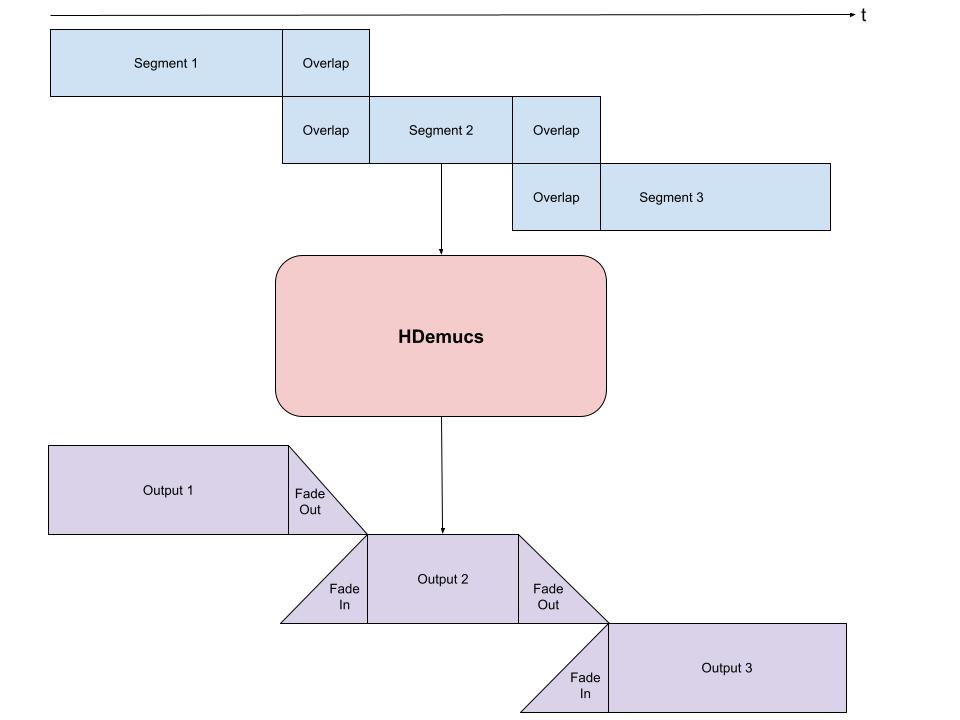
Because HDemucs is computationally intensive and memory-demanding, performing inference on an entire song in a single pass is often impractical.
In real-world deployments, long audio is typically processed using:
- Chunk-based segmentation
- Overlapping windows
- Fade-in / fade-out smoothing
This strategy is necessary because:
- Neural models tend to generate artifacts near segment boundaries
- Overlapping regions help reduce discontinuities and boundary noise
The processing strategy is illustrated below:
4.1 Implementing the Separation Function
from torchaudio.transforms import Fade


def separate_sources(
    model,
    mix,
    segment=10.0,
    overlap=0.1,
    device=None,
):
    """
    Perform music source separation using chunked inference.

    Args:
        segment: Length of each audio chunk in seconds
        overlap: Overlap ratio between consecutive chunks
        device: Inference device
    """

    if device is None:
        device = mix.device
    else:
        device = torch.device(device)

    batch, channels, length = mix.shape

    chunk_len = int(sample_rate * segment * (1 + overlap))

    start = 0
    end = chunk_len

    overlap_frames = overlap * sample_rate

    fade = Fade(
        fade_in_len=0,
        fade_out_len=int(overlap_frames),
        fade_shape="linear",
    )

    final = torch.zeros(
        batch,
        len(model.sources),
        channels,
        length,
        device=device,
    )

    while start < length - overlap_frames:

        chunk = mix[:, :, start:end]

        with torch.no_grad():
            out = model.forward(chunk)

        out = fade(out)

        final[:, :, :, start:end] += out

        if start == 0:
            fade.fade_in_len = int(overlap_frames)
            start += int(chunk_len - overlap_frames)
        else:
            start += chunk_len

        end += chunk_len

        if end >= length:
            fade.fade_out_len = 0

    return final
5. Spectrogram Visualization
Define a helper function for spectrogram visualization:
def plot_spectrogram(stft, title="Spectrogram"):
    magnitude = stft.abs()

    spectrogram = 20 * torch.log10(
        magnitude + 1e-8
    ).numpy()

    _, axis = plt.subplots(1, 1)

    axis.imshow(
        spectrogram,
        cmap="viridis",
        vmin=-60,
        vmax=0,
        origin="lower",
        aspect="auto",
    )

    axis.set_title(title)

    plt.tight_layout()
6. Running Source Separation
Use the official demonstration audio provided by Torchaudio:
SAMPLE_SONG = _download_asset(
    "tutorial-assets/hdemucs_mix.wav"
)

waveform, sample_rate = torchaudio.load(SAMPLE_SONG)

waveform = waveform.to(device)

mixture = waveform
Configure inference parameters:
segment = 10
overlap = 0.1
Normalize the waveform:
ref = waveform.mean(0)

waveform = (
    waveform - ref.mean()
) / ref.std()
Run source separation:
sources = separate_sources(
    model,
    waveform[None],
    device=device,
    segment=segment,
    overlap=overlap,
)[0]

sources = sources * ref.std() + ref.mean()
Store the separated stems:
sources_list = model.sources

sources = list(sources)

audios = dict(zip(sources_list, sources))
7. Model Outputs
The default Hybrid Demucs model produces four stems:
| Stem | Description |
|---|---|
| drums | Percussion and drum tracks |
| bass | Bass instruments |
| vocals | Lead and backing vocals |
| other | Remaining accompaniment |
8. Spectrogram Analysis
Configure STFT parameters:
N_FFT = 4096
N_HOP = 4

stft = torchaudio.transforms.Spectrogram(
    n_fft=N_FFT,
    hop_length=N_HOP,
    power=None,
)
9. Audio Segment Extraction
Extract the segment between 150s and 155s:
segment_start = 150
segment_end = 155

frame_start = segment_start * sample_rate
frame_end = segment_end * sample_rate
Load the corresponding reference stems:
drums_original = _download_asset(
    "tutorial-assets/hdemucs_drums_segment.wav"
)

bass_original = _download_asset(
    "tutorial-assets/hdemucs_bass_segment.wav"
)

vocals_original = _download_asset(
    "tutorial-assets/hdemucs_vocals_segment.wav"
)

other_original = _download_asset(
    "tutorial-assets/hdemucs_other_segment.wav"
)
Extract predicted segments:
drums_spec = audios["drums"][:, frame_start:frame_end].cpu()
bass_spec = audios["bass"][:, frame_start:frame_end].cpu()
vocals_spec = audios["vocals"][:, frame_start:frame_end].cpu()
other_spec = audios["other"][:, frame_start:frame_end].cpu()

mix_spec = mixture[:, frame_start:frame_end].cpu()
10. Rendering Spectrograms and Audio
Define a utility function for visualization and playback:
def output_results(
    original_source: torch.Tensor,
    predicted_source: torch.Tensor,
    source: str,
):

    plot_spectrogram(
        stft(predicted_source)[0],
        f"Spectrogram - {source}"
    )

    return Audio(
        predicted_source,
        rate=sample_rate
    )
11. Mixture Spectrogram
plot_spectrogram(
    stft(mix_spec)[0],
    "Spectrogram - Mixture"
)

Audio(mix_spec, rate=sample_rate)
12. Drum Separation Results
output_results(
    drums,
    drums_spec,
    "drums"
)
13. Bass Separation Results
output_results(
    bass,
    bass_spec,
    "bass"
)
14. Vocal Separation Results
output_results(
    vocals,
    vocals_spec,
    "vocals"
)
15. Other Accompaniment Results
output_results(
    other,
    other_spec,
    "other"
)
16. Full-Length Audio Playback
To listen to the complete separated stems, uncomment the following code:
# Original mixture
# Audio(mixture, rate=sample_rate)

# Drums
# Audio(audios["drums"], rate=sample_rate)

# Bass
# Audio(audios["bass"], rate=sample_rate)

# Vocals
# Audio(audios["vocals"], rate=sample_rate)

# Other accompaniment
# Audio(audios["other"], rate=sample_rate)
17. Conclusion
Hybrid Demucs integrates:
- Time-domain convolutional modeling
- Frequency-domain spectrogram learning
Compared with traditional source separation approaches, it offers:
- Higher separation fidelity
- Cleaner vocal isolation
- Reduced accompaniment leakage
This tutorial additionally adopts practical engineering strategies including:
- Chunk-based inference
- Overlap reconstruction
- Fade smoothing
These techniques effectively address long-audio inference challenges and are highly suitable for real-world deployment scenarios.
Typical applications include:
- AI singing voice conversion
- Vocal extraction
- Karaoke generation
- Music remixing
- Automatic arrangement
- Audio post-processing
References
The following references cover Hybrid Demucs, music source separation, and deep learning-based audio processing.
1. Hybrid Demucs
[1] Hybrid Spectrogram and Waveform Source Separation
Author: Alexandre Défossez
Venue: ISMIR 2021 Workshop
Year: 2021
Défossez, A. (2021).
Hybrid Spectrogram and Waveform Source Separation.
arXiv preprint arXiv:2111.03600.
Paper:
https://arxiv.org/abs/2111.03600
This work introduced the Hybrid Demucs architecture, which combines:
- Waveform-domain convolution
- Spectrogram-domain representation learning
It remains one of the most influential architectures in modern music source separation.
[2] Music Source Separation in the Waveform Domain
Authors: Alexandre Défossez, Nicolas Usunier, Léon Bottou, Francis Bach
Conference: ISMIR 2019
Year: 2019
Défossez, A., Usunier, N., Bottou, L., & Bach, F. (2019).
Music Source Separation in the Waveform Domain.
Proceedings of the 20th International Society for Music Information Retrieval Conference (ISMIR).
Paper:
https://arxiv.org/abs/1911.13254
This paper introduced the original Demucs architecture and pioneered waveform-based end-to-end music source separation.
2. Dataset References
[3] The MUSDB18 Corpus for Music Separation
Authors: Zafar Rafii et al.
Dataset: MUSDB18-HQ
Year: 2017
Rafii, Z., Liutkus, A., Stöter, F.-R., Mimilakis, S. I.,
Bittner, R., & Pardo, B. (2017).
The MUSDB18 Corpus for Music Separation.
Dataset:
https://zenodo.org/record/3338373
MUSDB18-HQ is one of the most widely adopted benchmark datasets for music source separation research.
3. PyTorch / Torchaudio Documentation
[4] Torchaudio Official Documentation
PyTorch Audio Team.
Torchaudio Documentation.
Documentation:
https://pytorch.org/audio/stable/index.html
[5] Official Hybrid Demucs Tutorial
PyTorch Audio Team.
Music Source Separation with Hybrid Demucs.
Tutorial:
https://docs.pytorch.org/audio/stable/tutorials/hybrid_demucs_tutorial.html
The implementation structure and experimental workflow presented in this article are partially inspired by the official tutorial.
4. Classical Research in Music Source Separation
[6] Open-Unmix — A Reference Implementation for Music Source Separation
Authors: Fabian-Robert Stöter et al.
Journal: Journal of Open Source Software
Year: 2019
Stöter, F.-R., Liutkus, A., & Ito, N. (2019).
The 2018 Signal Separation Evaluation Campaign.
Journal of Open Source Software.
Project:
https://sigsep.github.io/open-unmix/
[7] Wave-U-Net: A Multi-Scale Neural Network for End-to-End Audio Source Separation
Authors: Andreas Jansson et al.
Conference: ISMIR 2017
Jansson, A., Humphrey, E., Montecchio, N.,
Bittner, R., Kumar, A., & Weyde, T. (2017).
Singing Voice Separation with Deep U-Net Convolutional Networks.
Paper:
https://ismir2017.smcnus.org/wp-content/uploads/2017/10/171_Paper.pdf
5. Evaluation Metrics
[8] BSS Eval Metrics
Vincent, E., Gribonval, R., & Févotte, C. (2006).
Performance Measurement in Blind Audio Source Separation.
IEEE Transactions on Audio, Speech, and Language Processing.
Paper:
https://ieeexplore.ieee.org/document/1643671
This work introduced several classical evaluation metrics for source separation, including:
- SDR (Signal-to-Distortion Ratio)
- SIR (Signal-to-Interference Ratio)
- SAR (Signal-to-Artifacts Ratio)
6. Deep Learning for Audio Processing
[9] Deep Learning for Audio Signal Processing
Kellman, M., et al.
Deep Learning for Audio Signal Processing.
Publisher:
Cambridge University Press
[10] Fundamentals of Music Processing
Müller, M. (2015).
Fundamentals of Music Processing.
Springer.
Book website:
https://www.music-processing.de/
7. Recommended Resources for Further Study
| Topic | Resource |
|---|---|
| Demucs Official Repository | https://github.com/facebookresearch/demucs |
| PyTorch Audio | https://pytorch.org/audio/stable/index.html |
| Source Separation Community | https://sigsep.github.io/ |
| MUSDB Dataset | https://zenodo.org/record/3338373 |
| ISMIR Society | https://ismir.net/ |